Introduction
IT teams are drowning in technical data but can’t answer the executive question: “What is the business impact?”
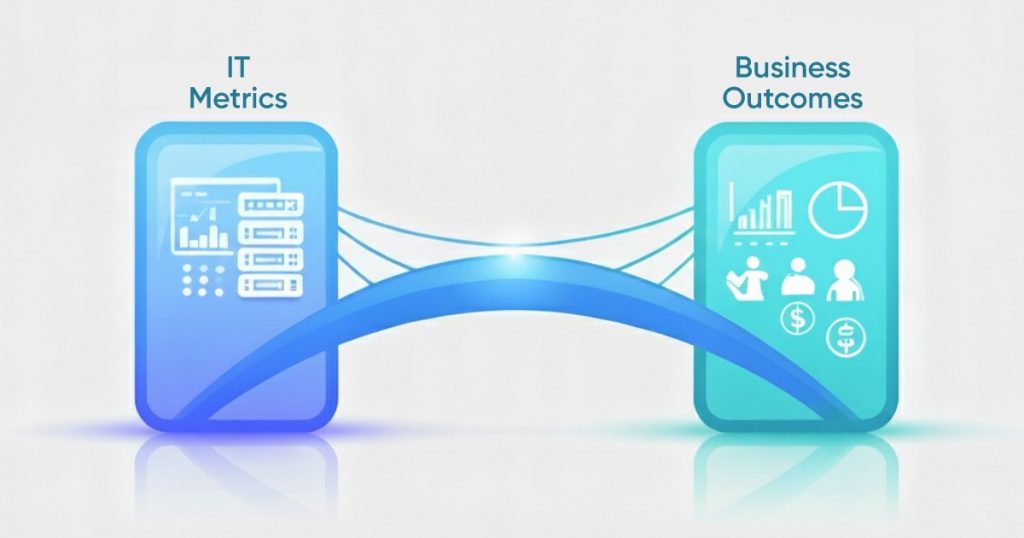
CIOs are under pressure to prove the direct link between IT metrics and business outcomes how uptime drives revenue, or latency impacts customer experience. This is critical as research shows less than half of digital initiatives meet their business targets (Gartner).
The problem isn’t lack of data, but lack of IT-business alignment metrics that translate technical performance into business language. New solutions, including agentic AI, event intelligence and outcome-based IT metrics are designed to close this gap.
This blog will outline strategies for aligning IT metrics with core business goals, explain traditional shortcomings and show how platforms like Scout-itAI deliver clear, actionable answers for both engineers and executives.
Why Traditional IT Metrics Don’t Tell the Business Story
Most businesses track IT metrics (CPU, memory, errors, incidents) but struggle to link them to business outcomes like revenue or customer impact. This disconnect is due to several issues:
- Multiple Tools: Teams use multiple observability tools, resulting in fragmented visibility and conflicting, often unactionable, alerts (87% of teams use multiple tools; 29% of alerts are actionable).
- Alert Fatigue: Operations teams are overwhelmed by thousands of daily alerts, with most ignored (4,484 daily alerts, 67% ignored), making it hard to focus on what matters.
- Domain Silos: Separate teams (cloud, network, app) use different tools and SLAs, preventing a single, cohesive reliability story based on outcome-based metrics.
- Language Barrier: IT technical terms (CPU utilization, BGP flaps) don’t resonate with executives who care about customer-centric metrics (conversion rate, churn, revenue at risk).
Aligning metrics with business strategy is key, as leaders who do so drive higher innovation and competitive advantage, require a shift from raw data to tightly linked IT metrics and business outcomes.
How Agentic AI and Event Intelligence Close the Gap
AI in observability isn’t just about anomaly detection. It’s about turning technical IT metrics into business outcomes through context, correlation and automation.Analysts predict that half of business decisions will be augmented or automated by AI agents in the coming years. Gartner This is already visible in monitoring: agentic AI can continuously analyze telemetry, forecast risk and surface insights in plain language.
Key roles for AI in bridging IT metrics and business outcomes:
- Event intelligence for IT operations: Instead of isolated alerts, AI clusters events into business-impacting incidents: “Users in APAC can’t complete payment due to network congestion on path X.”
- AI-powered IT observability insights: AI can highlight patterns humans miss: recurring degradation before peak hours, correlations between CDN changes and login failures, or network jitter before video drop-offs.
- Forecasting and simulation: Monte Carlo-style forecasting helps answer “How will this change impact our IT metrics and business outcomes?” before you deploy.
- Reducing MTTR with outcome-focused metrics: Agentic AI can automatically suggest remediation steps, escalate to the right teams and prioritize incidents based on revenue or customer risk not just severity codes.
This is exactly the philosophy behind Scout-itAI’s Event Intelligence Service (EIS).
CIO Reliability Scorecard Kit: Turning IT Metrics into Business Outcomes
Turning Technical Signals into Business Language with Scout-itAI
Scout-itAI is built to be a strategic partner for modern IT organizations especially those drowning in tools but starved for answers.
Here’s how it helps link IT KPIs to business value:
- Unified Reliability Score Across Domains
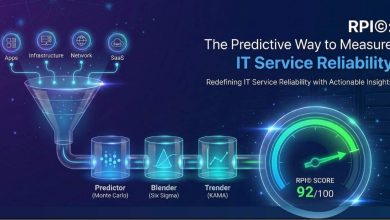
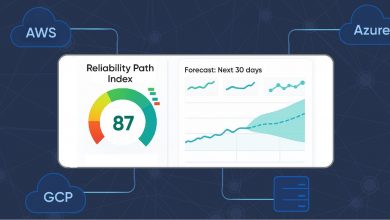
Scout-itAI’s Reliability Path Index (RPI Score) condenses thousands of metrics into a unified reliability score for each service path. Instead of juggling mainframe, cloud and SD-WAN metrics separately, leaders see one reliability metric for IT services that both IT and business stakeholders can understand.
This directly addresses questions like: “How do I see standardized scores of reliability from my mainframe to my cloud apps to my SD-WAN network?” - Predictor: Modeling the Business Impact of Change
With up to 100,000 Monte Carlo simulations, Scout-itAI’s Predictor estimates how architectural changes, capacity upgrades or vendor shifts could impact the RPI Score. That allows CIOs and VPs to measure IT value to the business by testing “what-if” scenarios before committing budget. - Blender & Trender: From Noise to Trend-Backed Insight
a) Blender applies Six Sigma-style analysis to alarms and metrics, surfaces performance-impacting patterns and eliminates redundant noise.
b) Trender, built on KAMA (Kaufman’s Adaptive Moving Average), tracks long-term behaviour against a 100-day baseline to detect early degradation. - Agentic Workforce: AI That Works Like a Tier-0 Ops Team
Scout-itAI’s Agentic Workforce framework uses orchestrators and sub-agents to:
1. Analyze complex telemetry across clouds and networks
2. Automatically escalate issues with business context
3. Suggest or trigger remediation actions to reduce MTTR
4. Maintain governance controls to minimize drift and hallucination
All of this is surfaced as plain-language IT metrics like:“Users in APAC can’t complete payment due to network congestion on path X.”
To see how this works in real-world hybrid environments, check out the Scout-itAI platform and its event intelligence.
What to Do CIOs and IT Leaders
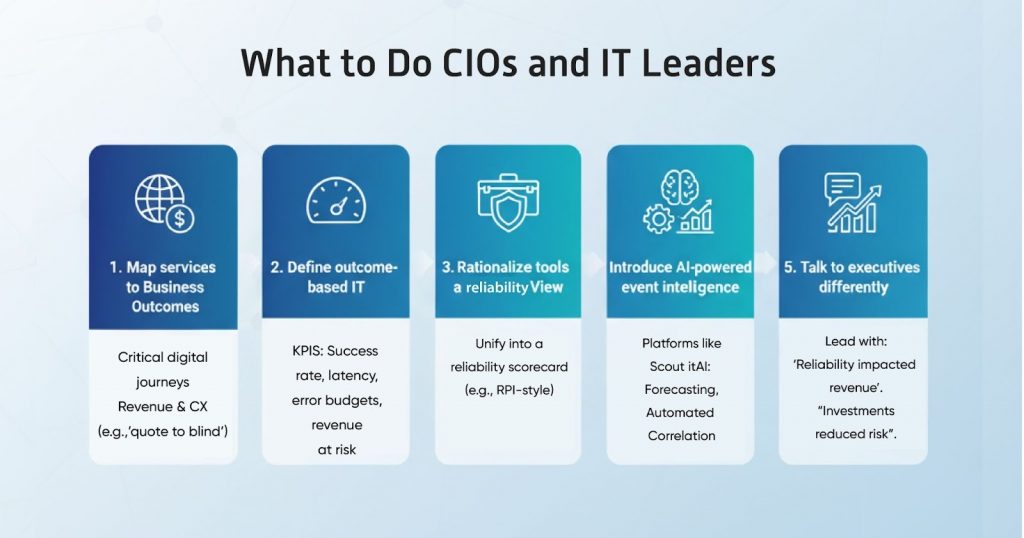
If you’re a CIO, VP of IT Operations or CDO trying to connect IT metrics to business outcomes here’s a practical roadmap:
- Map services to business outcomes
Identify 5–10 critical digital journeys (e.g., “quote to bind,” “checkout,” “claim submission”) and document how each generates revenue or impacts customer experience. - Define a small set of outcome-based IT metrics
For each journey, select IT KPIs for CIOs and IT leaders that tie directly to outcomes: success rate, latency thresholds, error budgets, and revenue at risk. - Rationalize tools around a reliability-centric view
You don’t need to rip and replace every tool but you do need a way to unify them into a reliability view, such as an RPI-style scorecard. - Introduce AI-powered event intelligence
Use platforms like Scout-itAI to add AI-powered IT observability insights, forecasting and automated correlation so teams can move from reactive firefighting to proactive risk management - Talk to executives differently
a) When presenting to the CEO or board, lead with:
b) Here’s how our reliability trends impacted revenue and customer experience.”
c) Here’s how our investments changed the reliability score and reduced risk.” - This is the right way to talk to the CEO about business impact, not infrastructure speak.
Conclusion
The days of reporting uptime and CPU charts in isolation are over. To win, organizations must connect IT metrics to business goals, use outcome-based IT metrics and leverage AI as a decision-making partner.
Scout-itAI makes this a reality with a reliability score, event intelligence for IT operations and agentic AI that links IT metrics to business outcomes for both engineers and executives to trust.
Ready to cut through noise, reduce alert fatigue and tell a clear, business-ready reliability story? Book a demo with Scout-itAI today.

Tony Davis
Director of Agentic Solutions & Compliance