From Complexity to Clarity: Simplifying Infrastructure Monitoring with Scout-itAI

Introduction
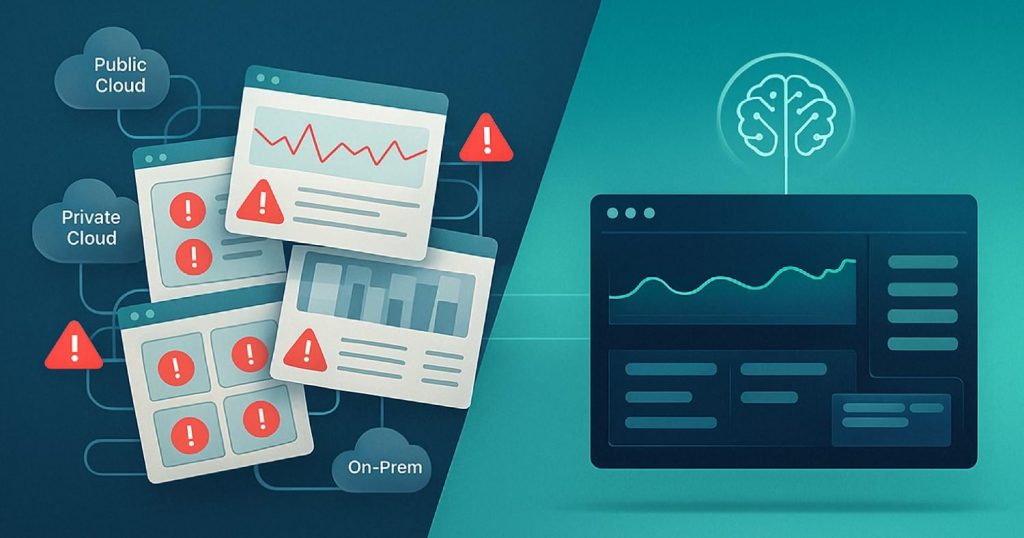
Infrastructure monitoring was supposed to make life easier. Instead, most teams are juggling a maze of tools, dashboards and “critical” alerts that never quite agree with each other. As hybrid and multi-cloud environments grow, simplifying infrastructure monitoring feels like a strategy and not a reality.
The result is a familiar pattern: alert fatigue, slow root-cause analysis and endless war rooms where everyone has data but no shared narrative. Network teams see one thing, application teams see another and business leaders are left asking the same question: “Are we actually reliable?”
This blog looks at how AI-powered infrastructure monitoring and true Event Intelligence can finally change that equation and how Scout-itAI helps IT, network and data leaders move from noisy complexity to clear, actionable reliability that everyone can understand.
Why infrastructure monitoring feels harder than ever
Modern infrastructure isn’t one stack it’s a tangle of:
- Legacy systems and mainframes
- SaaS and web applications
- SD-WAN and distributed networks
- Multi-cloud and hybrid cloud infrastructure (AWS, Azure, GCP, on-prem)
Hybrid cloud monitoring brings its own set of challenges: multiple platforms, distributed data and performance dependencies across on-prem and cloud services.
Tool sprawl is also out of control. Many MSPs and IT teams juggle 10+ monitoring tools, which contributes directly to burnout and operational drag.
For IT operations, NOC managers and data leaders, this looks like:
- Disconnected monitoring tools that never quite align
- Siloed metrics with no shared reliability story
- Too many monitoring alerts in hybrid cloud environments
- No single pane of glass for infrastructure monitoring
- Endless war-rooms to explain reliability to business stakeholders
What AI-powered infrastructure monitoring should actually do
A step-by-step guide to reduce alert fatigue without losing critical signals.
AI and AIOps are everywhere in marketing copy now but only a subset of platforms actually behave like event intelligence for IT operations.
Analyst guidance on AIOps and Event Intelligence Solutions highlights a few common capabilities: ingesting data across domains, applying ML for event correlation and noise reduction, enriching events with business context and automating incident response.
At a minimum, AIOps and AI-powered infrastructure monitoring should:
- Unify multiple monitoring tools into one view
- Perform AI-driven event correlation for IT alerts
- Deliver IT event correlation and noise reduction so only the most important incidents reach humans.
- Provide proactive infrastructure monitoring with AI (anomaly detection + prediction)
- Present insights in plain language that business and IT can both understand
Think of it as moving from “another dashboard” to a true IT operations analytics platform.
Traditional Monitoring vs Event Intelligence
| Category | Traditional Monitoring | AI-Powered Event Intelligence (like Scout-itAI) |
| Data sources | Siloed tools, point solutions | Unified, cross-domain telemetry (apps, infra, networks, cloud) |
| Alerts | Volume-based, noisy, redundant | Correlated incidents with noise reduction |
| Insights | Raw metrics and graphs | Plain-language diagnoses and business-aligned reliability insights |
| Response | Manual triage, ticket chasing | Automated triage, guided remediation, proactive forecasting |
Scout-itAI: Event Intelligence for Hybrid and Multi-Cloud Monitoring
Scout-itAI is a cloud-native Event Intelligence Service (EIS) designed to simplify hybrid cloud infrastructure monitoring and make reliability measurable across networks, applications and cloud paths.
Instead of replacing every tool you own, Scout-itAI sits above your existing observability stack (Splunk, Dynatrace, Broadcom DX NetOps/OI, AppNeta, and more), consolidating telemetry into a unified reliability model. It’s built for data-driven organizations that want more than raw metrics they want answers.
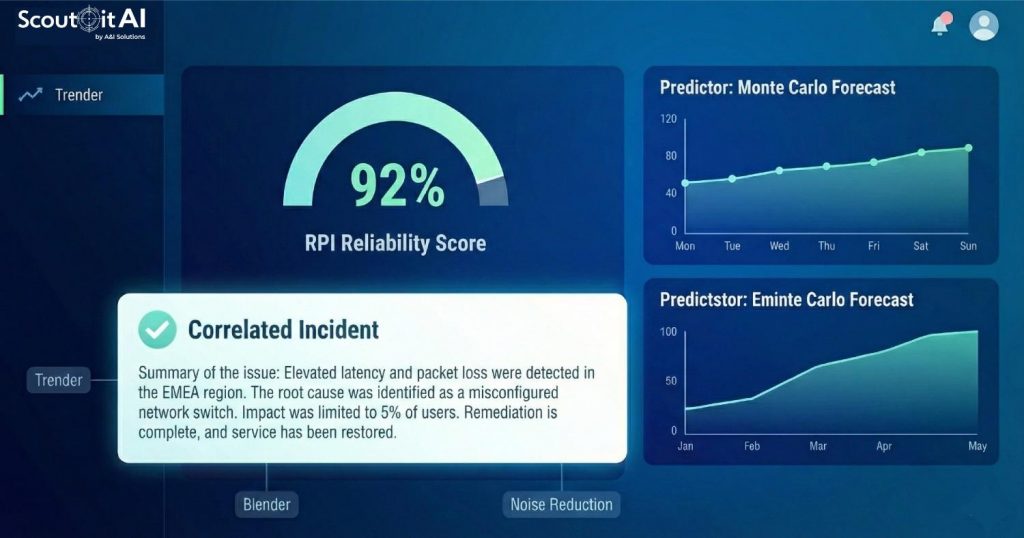
You can learn more about the platform’s foundations on the Scout-itAI home page and RPI-Index feature page.
Scout-itAI focuses on a few big promises:
- Universal hybrid cloud monitoring across AWS, Azure, GCP, and on-prem
- A patented Reliability Path Index (RPI score) to standardize reliability across domains
- Agentic AI that automates analysis, triage, and continuous improvement
- Noise reduction & business context alignment to reduce alert fatigue
Let’s unpack how.
RPI: one reliability score everyone can understand
Most dashboards are for engineers. RPI is for everyone.
The Reliability Path Index (RPI) takes thousands of metrics from up to 13 reliability buckets and 14+ monitoring domains and condenses them into one reliability score per service. It uses 15+ years of industry data so each score is a statistically reliable view of how good a service is.
On the product side, RPI has an R² of 0.9+, making it good for real-time triage and continuous improvement.
That means:
- IT teams see which delivery paths are weak, and why
- NOC managers can rank incidents by business impact, not just severity code
- CIOs and digital leaders get reliability scoring for IT services they can present to CEOs and boards
Predictor: Monte Carlo forecasting for IT incidents
Most tools tell you what happened. Scout-itAI’s Predictor shows you what’s likely to happen next.
Using Monte Carlo forecasting, Predictor runs up to 100,000 simulations to model how changes like adding capacity, rerouting traffic or updating a dependency will impact your RPI score and overall service reliability.
This gives you:
- Monte Carlo forecasting for IT incidents and reliability risk
- Scenario modeling: “What if we move this workload to another region?”
- Data-driven planning for reliability investment and technical debt paydown
For VP-level and C-suite stakeholders, this is the bridge from “we think this will help uptime” to reliability ROI.
Blender & Trender: cutting through alert noise with real trends
Scout-itAI doesn’t just correlate alerts it interrogates patterns.
Blender: Six Sigma for your alerts
The Blender engine applies real-time Six Sigma analysis to alarms and metrics. It looks for statistically meaningful variation and performance-impacting patterns across domains,so you can:
- Spot chronic issues hidden in day-to-day noise
- correlates across network, application, and infrastructure layers
- Prioritize fixes that move the RPI score
This aligns with best-practice AIOps approaches that focus on noise reduction and pattern recognition not just raw anomaly detection.
Trender: KAMA-based, long-term observability
Trender uses Kaufman’s Adaptive Moving Average (KAMA) over rolling windows (10, 30, 100, 200 days) to track long-term reliability trends and catch slow-burn degradations early.
Instead of reacting only to hard failures, teams can:
- See when a service is drifting out of its comfort zone
- Detect latency or data loss trends before customers feel them
- Compare current health to a 100-day baseline for each key path
This combines Blender and Trender to upgrade your monitoring from “what’s broken now?” to continuous, reliability improvement.
Agentic AI: from alerts to plain-language answers
Scout-itAI’s agentic workforce framework uses orchestrator and sub-agents to:
- Ingest events and telemetry from all your monitoring tools
- Run RPI, Blender, Trender, and forecasting pipelines
- Generate plain-language insights tied to business risk
- Automate or recommend remediation tasks
This is where the platform differs from “just another AI bot.” Instead of generic chat, you get contextual guidance like:
- “RPI for payments dropped 5 points in the last hour, mainly due to increased latency on network link Y.”
- “If you move 30% of traffic from Region A to Region B, projected RPI improves from 81 to 88 with 95% confidence.”
You can learn more on the: AI feature page and the Cloud monitoring usecase.
The result: reduce alert fatigue in IT operations, improve MTTR with AIOps and event intelligence, and give everyone from NOC to CDO a shared, reliability-first view of infrastructure.
What this means for IT, network, and data leaders
For your personas, Scout-itAI helps:
- IT Operations & NOC Managers
a) Fewer, richer incidents thanks to IT event correlation and noise reduction
b) Faster MTTR with AI-generated root-cause storie
c) Single pane of glass for mainframe, cloud apps, and SD-WAN - Network Operations & Network Performance Directors
a) User and location based performance monitoring with context
b) prove how network changes impact RP
c) Hybrid cloud outage prevention with AI forecasting - CIOs, CDOs, and Digital Leaders
a) Business-friendly reliability scoring for IT services
b) Data driven investment decisions (where to spend for the biggest reliability gain)
c) Reliability conversations with the CEO without tech speak
Conclusion
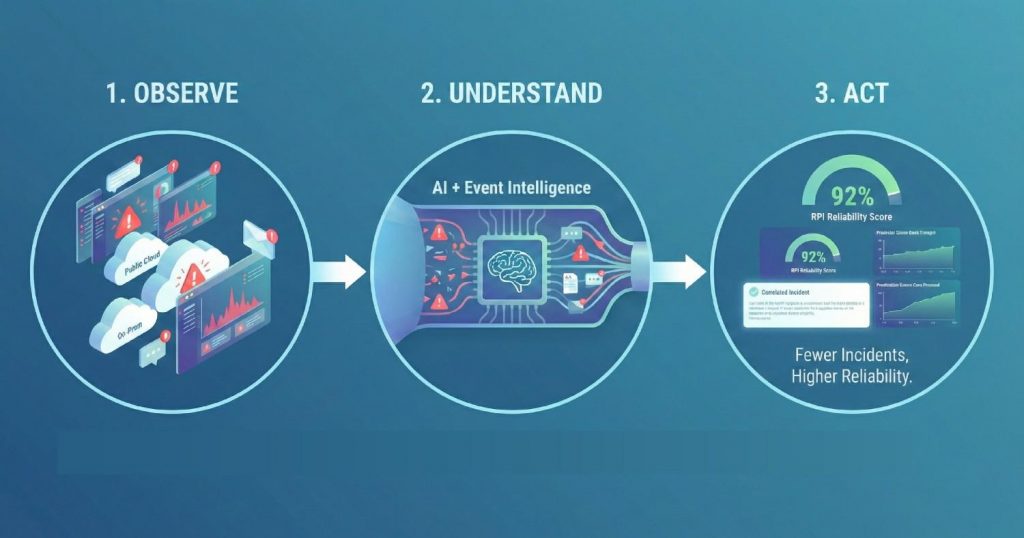
Infrastructure isn’t getting simpler but you can monitor it simpler. If your stack feels like a bunch of disconnected tools, it’s time to move from noise to narrative with AI-powered infrastructure monitoring and Event Intelligence that turn raw telemetry into one clear story.
- Unified infrastructure monitoring across hybrid and multi-cloud
- Event intelligence for IT operations with real forecasting
- Plain-language answers about what’s failing, why, and how to fix it so everyone from engineers to executives can understand
Visit Scout-itAI at scoutitai.com or Schedule a Scout-itAI Demo to see how fast you can get from complexity to clarity.
Frequently Asked Questions
AI-powered infrastructure monitoring uses machine learning and event intelligence to analyze metrics, logs, and network data in real time, automatically detecting issues, correlating events, and providing plain-language insights instead of raw, siloed alerts.
Scout-itAI ingests alerts from multiple tools, applies AI-driven event correlation, and filters out redundant or low-impact noise. It groups related alerts into incidents, ranks them by business impact using the RPI score, and guides teams on what to fix first.
The RPI score is Scout-itAI’s patented reliability metric that condenses thousands of telemetry points and 13+ reliability buckets into a single score per service. It standardizes reliability across apps, networks, and cloud paths so both IT and business can track improvements.
Yes. Scout-itAI is a cloud-native Event Intelligence Service that supports hybrid cloud infrastructure monitoring across AWS, Azure, GCP, and on-prem, giving you a unified view of performance and reliability across environments.
Scout-itAI connects to your existing observability and monitoring platforms such as network tools, APM, log analytics, and cloud monitors and ingests their telemetry. It then layers RPI scoring, AI-driven event correlation, and forecasting on top, without forcing a rip-and-replace.
Scout-itAI’s Predictor runs thousands of Monte Carlo simulations on your reliability data to estimate how changes like configuration updates, capacity shifts, or routing changes are likely to affect your RPI score and incident risk, helping you plan changes with confidence.
By translating complexity into RPI scores and clear narratives, Scout-itAI lets CIOs, CDOs, and business leaders see how reliable key journeys (checkout, login, claims, etc.) are over time, and how IT changes are improving or degrading customer experience.
Traditional AIOps tools often focus on anomaly detection and generic alert correlation. Scout-itAI adds a patented reliability scoring model (RPI), Six Sigma analysis, KAMA-based trend tracking, and Monte Carlo forecasting to deliver a reliability story that’s tightly aligned to business outcomes.
Most teams begin with a focused set of critical services and monitoring integrations. With Scout itAI’s agentic AI and prebuilt reliability models, organizations typically see reduced alert noise and clearer incident context within days of onboarding.
Yes. Scout-itAI is designed for enterprises in finance, healthcare, government, and other regulated sectors. Its reliability scoring, audit-friendly insights, and ability to unify monitoring data help teams meet compliance SLAs while improving resilience.

Tony Davis
Director of Agentic Solutions & Compliance