Introduction
Modern IT environments are more distributed and complex than ever, applications, networks, cloud services and on-prem systems yet most teams still use disconnected dashboards, siloed metrics and traditional monitoring tools that can’t keep up.
The result is tool sprawl, alert fatigue, slow root-cause analysis, and executives asking for clear answers in business language, not technical jargon. The future of observability is about changing that: using an AI-powered observability platform and Event Intelligence Service to correlate signals across domains, forecast risk before incidents, and deliver plain-language, reliability-focused insights.
That’s exactly the role Scout-itAI is built to play helping organizations make faster, smarter, and more business-aligned IT decisions.
Claim your RPI© Reliability Guide and start forecasting reliability outcomes with accuracy and confidence.
Why Traditional Observability Isn’t Enough Anymore
Most enterprises have grown their observability stack one tool at a time: APM here, NPM there, a few log aggregators, some cloud monitoring, and several network probes. Useful individually, but together they create a fragmented, confusing view of service health.
1. Tool Sprawl and Fragmented Visibility
Teams often manage 10+ monitoring tools across vendors like Splunk, Dynatrace, Broadcom DX NetOps/OI, AppNeta and cloud-native services. The problem: No unified reliability metric across hybrid cloud and no way to prioritize what actually matters.
2. Siloed Metrics Without Context
Tools collect everything logs, traces, SNMP traps, metrics but without connection or context. Instead of insight, teams get noise. Leaders want answers: What’s wrong? Why did it happen?
3. No Standardized Reliability Score Across Domains
Every layer of the stack speaks its own language: SD-WAN Mainframes Cloud-native microservices There’s no way to say, “This service is reliable.”
4. Slow, Reactive Troubleshooting
Root cause analysis often involves:
- War rooms
- Scroll-back marathons
- Long Slack threads
- Lengthy bridge calls
MTTR stays high because humans do work machines could do faster.
5. Difficulty Communicating with the Business
Executives need:
- Executive-ready reliability scorecards
- Business-friendly dashboards
- Simple explanations of risk and impact
Most observability tools talk in metrics; the business wants outcomes
This is why the industry is shifting toward AI observability for hybrid cloud with a focus onbusiness-centric insight, not technical noise..
Agentic AI: The Next Wave of Observability
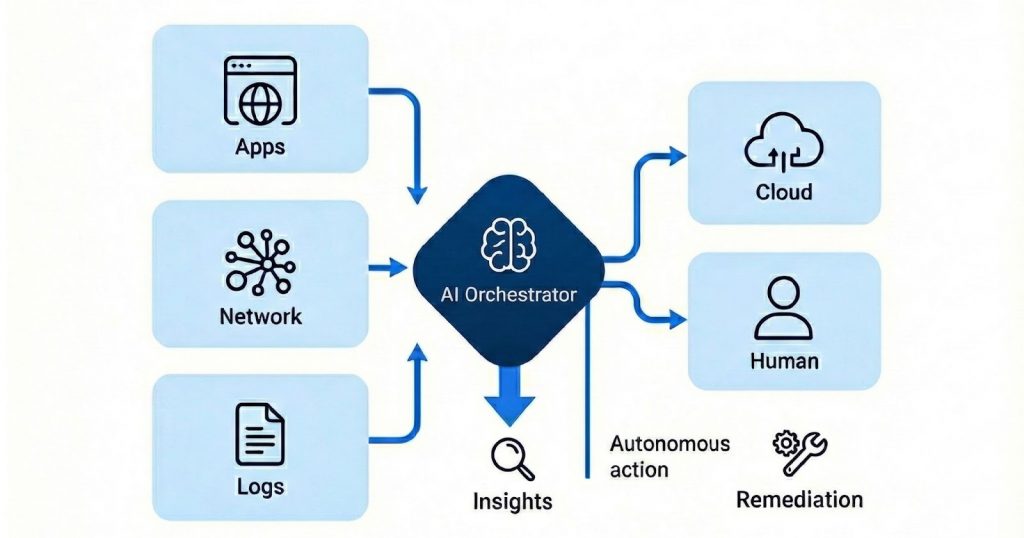
The biggest change today is moving from AI that helps humans to AI that runs operations. Agentic AI is like a smart teammate that:
- Watches everything 24/7
- Connects the dots across apps, networks, and clouds
- Uses domain-specific sub-agents
- Acts before things break
- Suggests or triggers fixes
What Agentic AI Unlocks
1. AI Incident Root Cause Analysis- Analyzes thousands of signals in seconds
- Gives you a clear story: what failed, where it failed, why
- Automates correlation across tools and domains
- Eliminates “dashboard hunting” and manual investigation
- Reduces MTTR and team burnout
- Translates technical data into plain English
- Tells you what happened, who’s affected, how bad it is
- Makes insights available to technical and non-technical people
- With proper governance, AI agents can:
a ) Escalate issues
b) Reconfigure failing components
c) Stabilize degraded paths - Enables safe autonomous remediation and self healing IT systems
RPI: The Unified Reliability Score Modern Teams Need
Scout-itAI introduces RPI (Reliability Path Index) a 13-bucket reliability scoring model backed by 15+ years of industry data.
RPI compresses thousands of low-level metrics into one standardized reliability score for any service path.
Why RPI Matters
- Service reliability scoring across applications, networks, cloud and on-prem
- Unified reliability metric across hybrid cloud
- Reliability index for applications and networks
- Business-friendly reliability dashboards
Executives get clarity. Engineers get precision. Teams get alignment.
Predictive Intelligence: See Reliability Risks Before They Happen
Traditional observability looks backward.
Predictive observability looks forward.
Scout-itAI’s Predictor, powered by Monte Carlo forecasting, runs 100,000 simulations to estimate how changes will affect RPI.
With Predictor, you can:
- Forecast reliability trends
- Simulate reliability ROI before investing
- Predict RPI score changes before risky deployments
- Plan reliability and capacity with confidences
Teams move from gut feel to probability-based risk decisions.
Reducing Noise & Alert Fatigue with Six Sigma Analytics
Alert noise creates
- Burnout
- False alarms
- Hidden real issues
Scout-itAI’s Blender applies real-time Six Sigma analytics to identify patterns in alerts and metrics.
Benefits:
- Fewer false positives
- Clear signal vs noise prioritization
- Stronger cross-domain event intelligence
- Better identification of high-impact incidents
Trend Detection with Kaufman’s Adaptive Moving Average (KAMA)
Not every spike is a crisis. Not every crisis is a spike.
Scout-itAI’s Trender uses KAMA to compare performance to a 100-day rolling baseline.
Trender provides:
- 100-day reliability trend analysis
- Early detection of subtle degradation
- Trend-based anomaly detection
- Visibility into slow-burn issues traditional tools miss
This shifts teams from reactive firefighting to proactive reliability engineering.
Hybrid Cloud Observability… Without the Complexity
Most organizations run a mix of:
- AWS, Azure, GCP
- SaaS apps and APIs
- Legacy data centers
- SD-WAN and remote sites
Scout-itAI offers hybrid cloud monitoring with up to 12 months of performance visibility, creating a unified observability data fabric.
The result
- Consolidated cross-provider views
- Detection of cross-domain issues
- RPI-based reliability model across all environments
Why CIOs, CTOs and Data Leaders Are Turning to AI Observability
Leadership needs an observability strategy that:
- Aligns IT reliability to business outcomes
- Reduces tool sprawl and operational overhead
- Provides transparency for executives and boards
- Enables data-driven investment decisions
Scout-itAI bridges technical metrics and strategic decisions through business-centric reliability reporting and AI-powered insights.
Conclusion
Observability is no longer about collecting more data it’s about generating meaning
AI-powered platforms like Scout-itAI help organizations:
- Standardize reliability scoring
- Predict failures before they cause damage
- Reduce MTTR through automation
- Deliver plain-language insights to stakeholders
- Unite cloud, network and application reliability
The organizations that thrive will be those that adopt intelligent, predictive, cross-domain observability today.
Explore the Scout-itAI platform or Book a Demo to see how an AI-powered Event Intelligence Service can transform your observability approach.
Frequently Asked Questions
It uses ML, agentic AI and automated analytics to ingest telemetry, correlate events, predict issues and deliver real-time insights moving beyond dashboards to AI-generated insights and recommendations.
RPI is a 13-bucket scoring model that compresses thousands of metrics into one standardized reliability score for any service.
YIt runs thousands of simulations to estimate how changes affect reliability, allowing teams to predict RPI shifts, simulate ROI and plan safer changes.
It uses orchestrator and sub-agent models to autonomously analyze issues, correlate events and trigger remediation under governance controls.
Its Blender engine applies Six Sigma analytics to filter noise, remove false positives and correlate cross-domain events.
An EIS unifies and correlates data from existing tools into one reliability-focused view rather than generating more raw metrics.
Yes AWS, Azure, GCP, on-prem, SD-WAN, legacy systems and more.
No. Scout-itAI integrates with Splunk, Dynatrace, Broadcom, AppNeta and others to reduce tool sprawl.
Scout-itAI converts telemetry into plain-language insights and executive-ready scorecards.
Faster resolution, fewer false alarms, clearer RPI scores, smarter investment decisions and better resilience.

Tony Davis
Director of Agentic Solutions & Compliance